
Why estate boards need the right UV ink mix
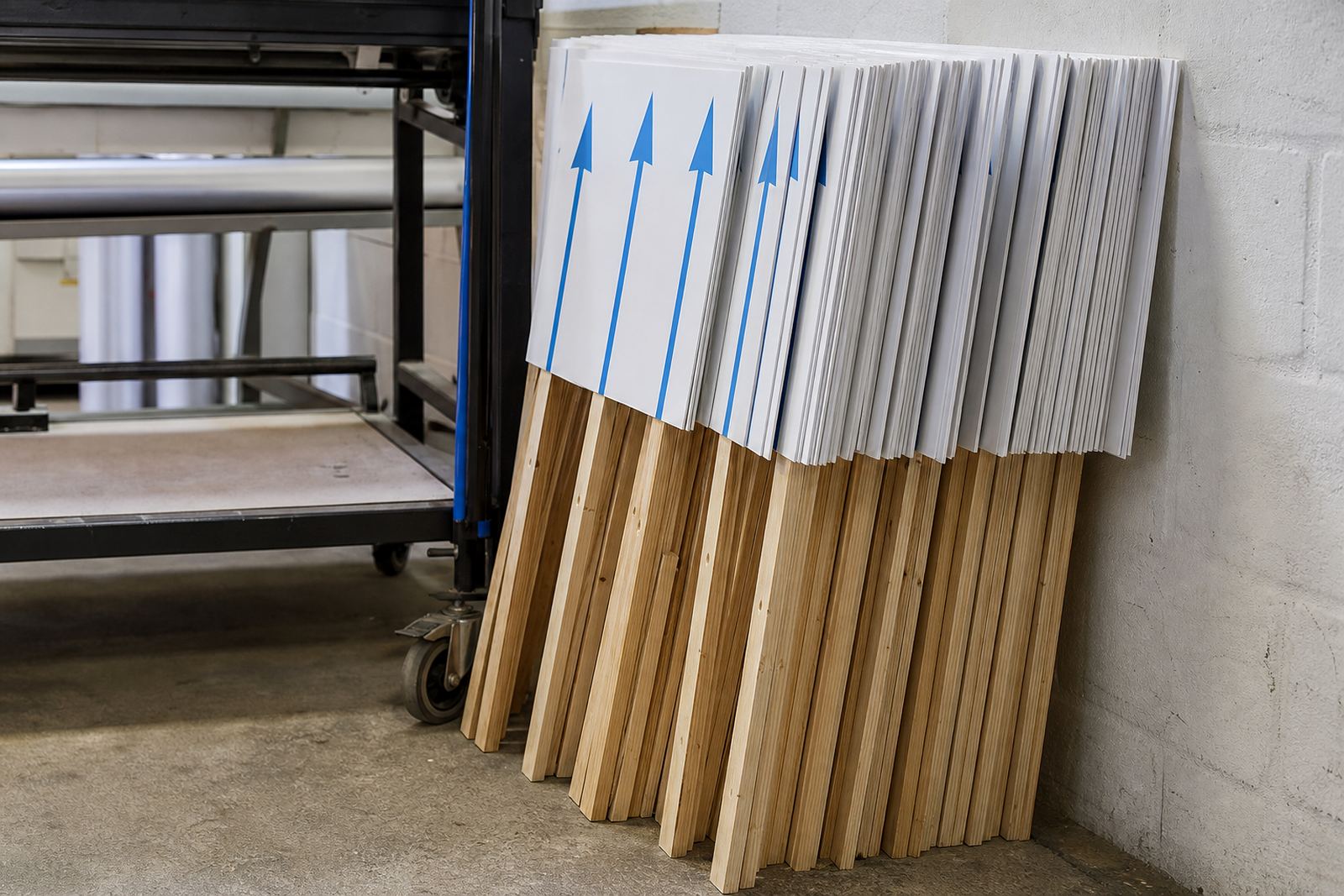
Estate agency boards are often printed on fluted plastic sheets because they are light, affordable and easy to mount on poles, walls and fences. The challenge is not only colour, but how the ink grips the sheet, cures under the lamp and keeps its finish when the board sits in Cape Town wind, summer heat or humid coastal air.
In our experience, the best results come from matching the ink to the substrate and the printer setup rather than pushing one generic option across every job. That means checking whether the board is corona treated, how the surface feels, what lamp system is fitted and whether the job needs speed, extra adhesion or a tougher finish for outdoor use.
Typical printer setup for fluted plastic boards
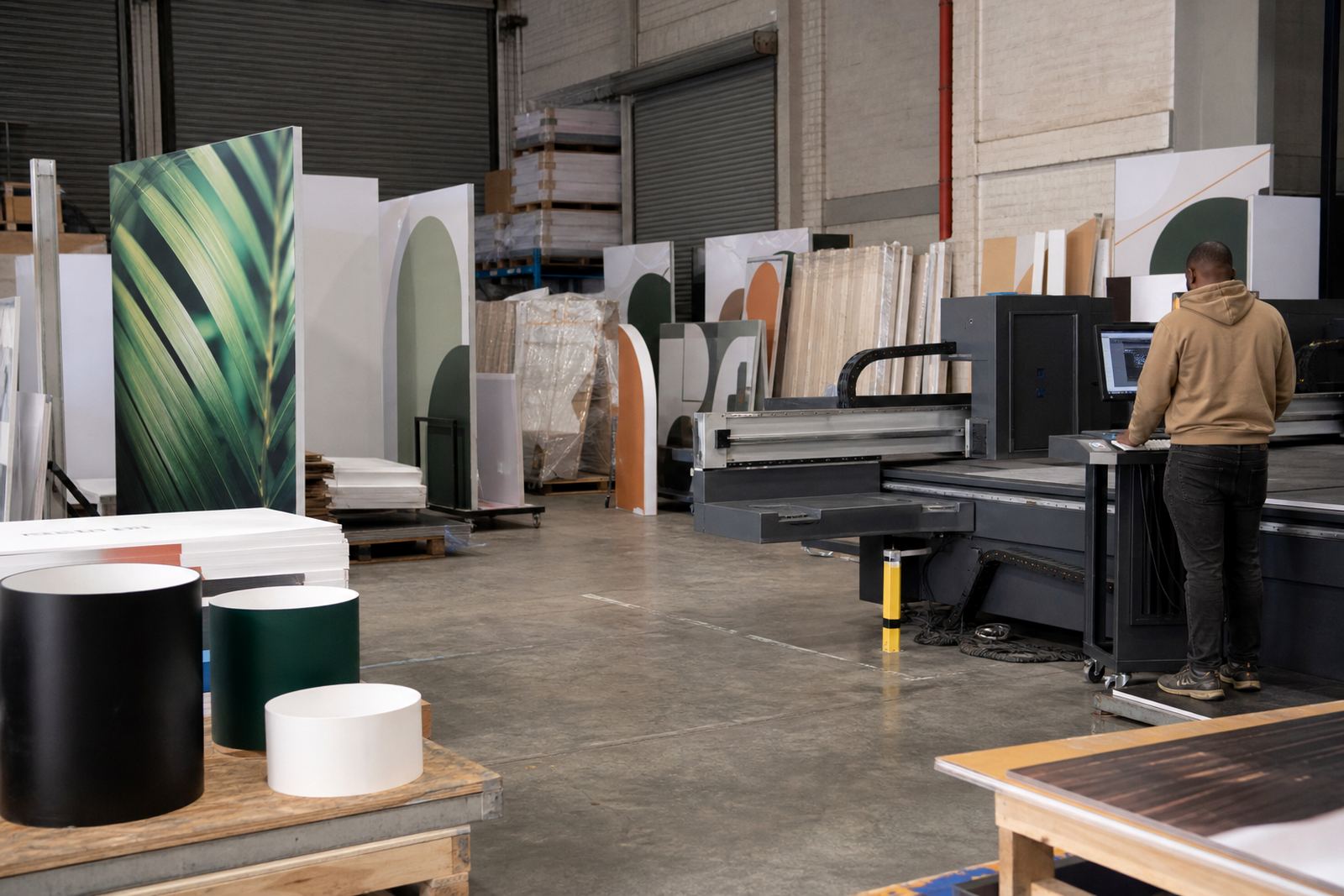
Most estate board work is done on a flatbed printer for direct print onto rigid sheets, or on a roll-to-roll machine when the layout is being printed onto a flexible face stock first. The print room usually needs clean boards, stable humidity and operators who can keep dust off the surface before printing. Even a small amount of grit can affect adhesion, especially on white or light coloured panels where defects show quickly.
For a practical set-up, the job often includes:
- A flatbed or roll-to-roll UV printer with the correct ink channel setup
- Surface cleaning cloths and lint removal before print
- Test sheets for colour and adhesion checks
- Appropriate lamp settings for the ink and substrate
- Dry storage space for sheets before dispatch
If you are printing in Johannesburg or Pretoria, dust control matters. In Durban and Gqeberha, moisture and salt air can change how a board behaves after printing, so a quick test run is worth more than guesswork.
Layout and planning tips for readable boards
Estate boards live or die by readability. The message has to be seen from a moving car, often in bright sun, and sometimes in poor light at dusk. Keep the wording short, use a strong contrast between background and text, and avoid thin lettering that breaks up from a distance. Boards that are too crowded look busy and the main contact message gets lost.
Before a batch goes to print, we suggest confirming a few simple points:
- Board size and final mounting direction
- Text height for main wording and directional arrows
- Safe margins so clips, ties or holes do not cut into the print
- Whether the board needs one side or two sided print
- Any postcode, suburb or area name that must stand out
For Bellville, Paarl and other high traffic areas, clear directions and large type usually work better than fancy layouts. A neat board with correct spacing and colour contrast will often outperform an over-designed one.
Adhesion, curing and finish control
UV inks cure when exposed to the right wavelength and intensity of light, but curing is not only about switching the lamp on. Too little cure leaves the print soft, while too much can make the surface brittle or affect colour. The right balance depends on ink load, print speed, substrate type and the printer's curing system.
Adhesion testing should be part of the normal workflow, especially on new stock or when a supplier changes board grade. A simple tape test or scratch check can save time and money later. Follow the safety data sheet for the ink, wear gloves when handling liquid ink and freshly printed sheets, and keep the print room ventilated. If a board will be exposed to strong sun or coastal conditions, ask for curing guidance before the run rather than after the first failure.
Common mistakes that push up reprint costs
The most common problems with estate boards are avoidable. Some jobs fail because the operator assumes all fluted plastic accepts ink the same way. Others fail because the board was stored in a damp area, handled with dirty hands or packed before the ink had properly cured. In a busy week, it is easy to miss one small step and end up with scuffed corners or poor adhesion.
Watch out for these mistakes:
- Skipping a compatibility check before bulk production
- Printing onto dusty or contaminated sheets
- Using the wrong speed and lamp setting for the ink
- Stacking boards too soon after print
- Ignoring one-sided and two-sided layout differences
We also see problems when teams rush out repeat orders without checking whether the board supplier or sheet thickness has changed. A small change in substrate can affect both colour and hold-out. That is why sample pack prep and colour trial support can be useful before a large run.
Budget ranges and buying for regular board work
For estate boards, costs are usually shaped by ink usage, sheet size, coverage, test runs and how often the artwork changes. A small run for a single listing area may need only a few boards, while a national or multi-branch property campaign can turn into repeat production over several towns. As a general planning guide, budget for entry-level sample and test work at around R500 to R1 500, small production top-ups from about R2 000 to R5 000, and larger recurring supply orders from around R6 000 upward, depending on the printer and coverage required.
If your team prints across Cape Town, Johannesburg, Durban, Pretoria and Gqeberha, it helps to keep repeat order management simple. That means agreed stock levels, a clear note of which board size is used most often, and a plan for courier delivery so urgent jobs do not stall when stock runs low. We supply from Epping, Cape Town and support production planning, remote tech help and operator training for teams that want fewer stops and fewer mistakes.
How our team supports estate board production
Estate board work tends to be time-sensitive, so support has to be practical. Michael van Wyk heads the business, with Lindiwe Maseko on sales, Hennie Opperman on technical support, Shanaaz Allie on operations, Moagi Shirinda on logistics, Nadine Motaung on customer service and Thabo Steyn on training. That means you can ask for ink selection, compatibility checks, adhesion testing, curing guidance, sample pack prep, production planning, operator training, safe handling briefing and courier stock support without having to chase different people for every detail.
For an ink order, write to UV Ink through the contact page form with your printer model and ink colours, and we assist with supply into Bellville, Paarl and right across South Africa. If your estate agency needs quick board turnaround, clear colour and reliable print behaviour, the best approach is usually to test the substrate first, confirm the settings, then scale up with confidence.