
Why menu boards need more than good colour
Menu boards are often viewed in bright shop lighting, near kitchens, or in delivery collection areas where surfaces get wiped down often. That means the ink has to do more than look bright on day one. It needs to cure properly, hold fine lettering, and stay attached to the board material without lifting at the edges.
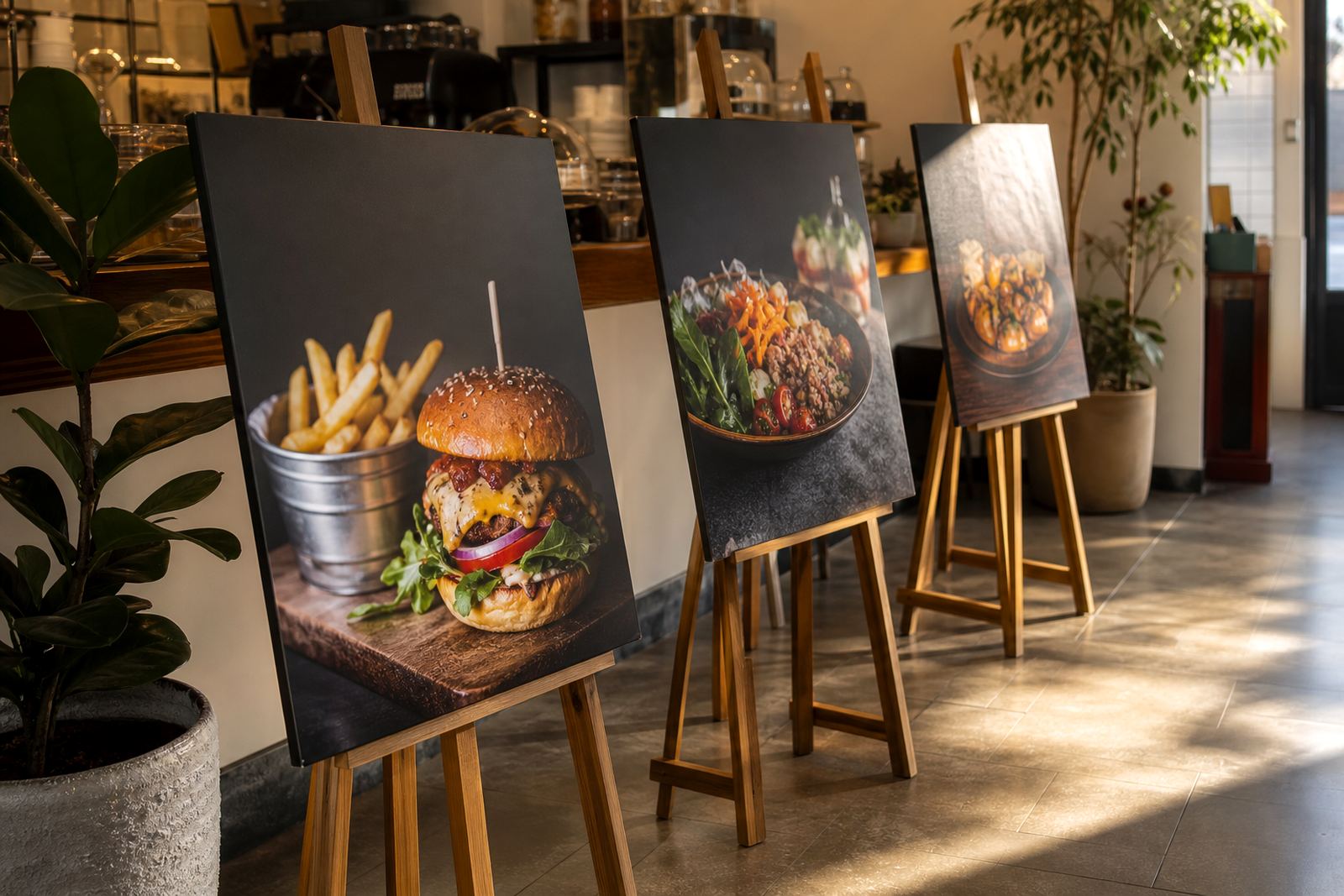
For printed menu boards, UV-curable inks are commonly chosen because they cure quickly under UV light and can leave a firm surface that handles handling better than many softer ink systems. In practical terms, that helps when you are producing counter menus, wall menus, specials boards and interior food-service graphics for cafés, takeaways, bakeries and quick-service counters.
At our Epping base in Cape Town, we often speak with businesses that need the same job repeated across several branches. The challenge is usually not just print quality, it is keeping colour, legibility and finishing consistent from one board to the next.
Typical printer setups for this kind of work
Menu board production can be handled on flatbed printers for rigid boards or on roll-to-roll printers when the artwork is printed onto flexible media first. The right ink choice depends on the printer chemistry, the substrate and the final location of the menu board. A coated panel for an indoor café wall is not the same as a board that sits near the entrance of a coastal takeaway in Durban where humidity can be higher.
- Flatbed printers for acrylic, foam board, PVC sheet, composite panels and other rigid materials
- Roll-to-roll printers for self-adhesive vinyl, banner material and some coated flexible media
- Finishing equipment such as cutters, laminators and mounting tools for final assembly
- UV curing systems matched to the printer and ink set so the print reaches full cure
Compatibility matters. A clean result depends on the ink matching the print head type, the substrate and the curing settings. If the ink is not tuned properly, you may see poor adhesion, dull colour or surface tack that causes problems during finishing.
Layout planning for readable menus
Good menu boards are planned around reading distance. A customer at the counter should be able to scan item names, prices and categories quickly without squinting. That usually means strong contrast, clear spacing, and a layout that avoids crowding too much information into one board.
For multi-board restaurant interiors, it helps to group related items and keep pricing in one aligned column. If the board is going into a space with glare from pendant lights or daylight through glass, matte finishing or careful panel placement can help reduce reflection. In Cape Town and Gqeberha especially, you also want to think about coastal humidity and whether the board will be cleaned with damp cloths every day.
When we help with production planning, we often suggest test prints first. A small colour trial can show whether reds, blacks and pale text hold properly on the chosen material. That saves time later if a board needs rework before a full print run.
- Use bold type for headings and keep body text simple
- Leave enough white space between items and price blocks
- Check the print at actual viewing height before approving the full run
- Allow for trimming, mounting and any edge finishing before final sign-off
Adhesion and curing on common menu board materials
Menu boards can be printed on a range of materials, but not every surface behaves the same. Some boards have smooth coatings that accept ink well, while others need more careful preparation. Adhesion testing is important because a print that looks fine straight off the machine can still fail later if the surface and ink combination is wrong.
UV-curable inks rely on correct curing to reach their intended finish. If the lamp output, print speed or pass settings are off, you may end up with under-cured ink that marks easily or over-cured areas that affect flexibility. This is especially important on boards that are cut after printing or mounted close to heat sources in food-service areas.
For safety, always follow the safety data sheet and wear gloves when handling ink, cleaning parts or dealing with waste materials. Good workshop practice matters just as much as the print settings. That includes keeping lids closed, storing products correctly and avoiding unnecessary skin contact.
Common mistakes that cause reprints
Many menu board problems come from rushing the setup. The artwork may be approved, but the board still fails because the wrong substrate was used, the curing settings were not checked, or the colours were not tested under the room lighting where the menu will actually hang. A neat file on screen does not always print neatly on a real panel.
Another common issue is using a printer-ink combination that has not been checked for the job. If the print heads, ink type and media are not compatible, the result can be patchy coverage or poor adhesion around fine text and logo areas. In busy kitchens or front-of-house spaces, that sort of error shows quickly.
- Skipping adhesion tests on new board material
- Printing too small for the intended viewing distance
- Ignoring glare from lights or windows
- Not allowing for heat, wiping and regular handling
- Ordering only enough ink for the first run and nothing for repeats
Our team can help with sample pack prep, remote tech help and repeat order management so the same menu board job can be reproduced without starting from scratch each time.
Budget ranges for menu board production
Budget depends on the board size, material, number of colours, finishing method and whether you are producing one-off boards or a full set for multiple branches. A small counter menu can be far less costly than a large wall-mounted board with several panels and cut-outs. If you are adding colour trials, sample packs or operator training, allow for those steps in the job plan too.
As a practical guide, simple interior menu board jobs might start in the lower thousands of Rand for materials and print consumables, while larger multi-panel sets or repeated roll-to-roll runs can move into higher ranges depending on substrate and finish. The real saving usually comes from getting compatibility right first time, because reprints and rework cost more than careful planning.
We supply from Epping, Cape Town and arrange We courier UV ink to Cape Town, Johannesburg, Durban, Pretoria, Gqeberha and other centres. Branches in Bellville and Paarl are also served through our delivery network. If your food-service team needs ink selection, curing guidance or training before the next production run, the enquiry form on our contact page is the right place to start.