
Why safety signs need dependable UV ink
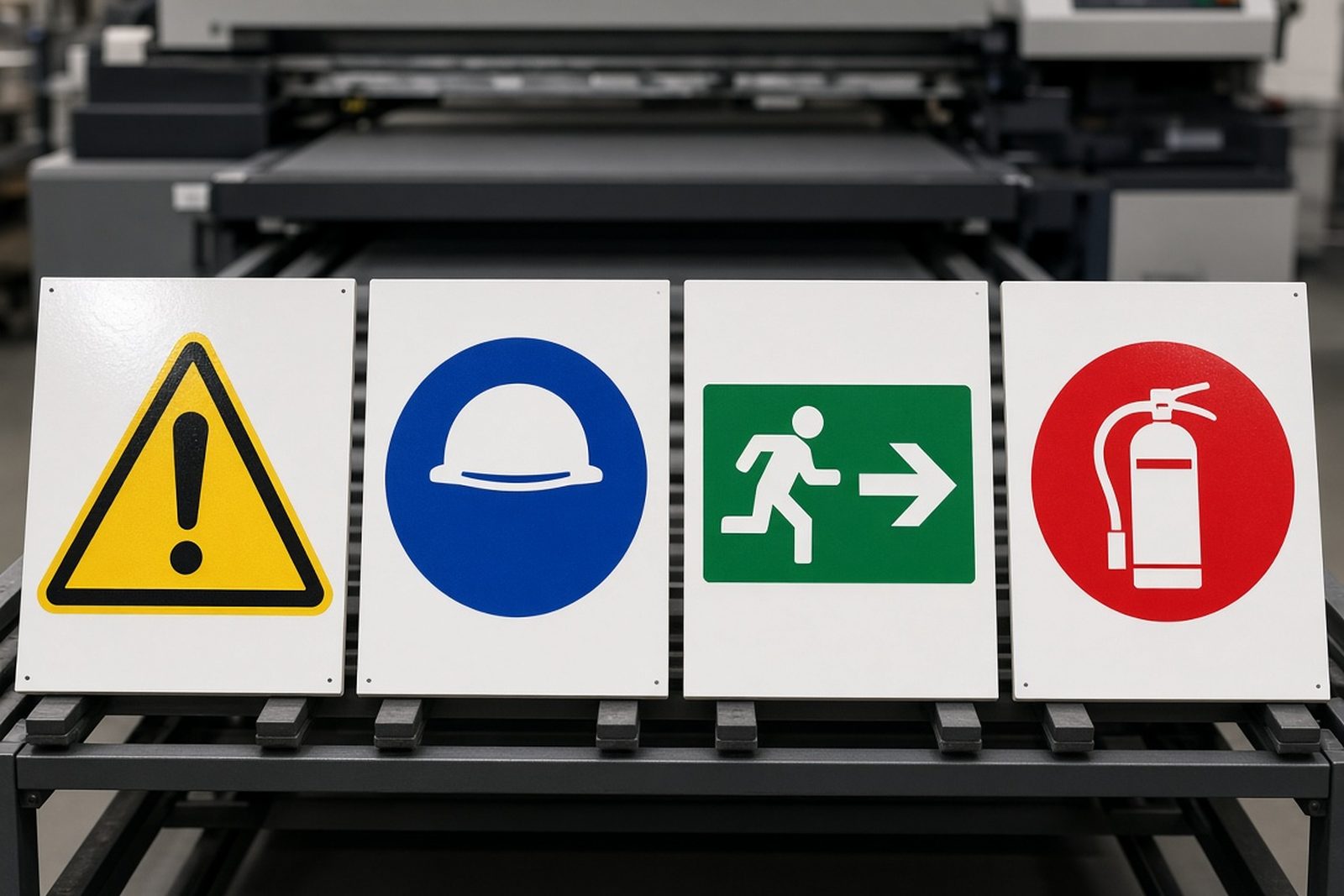
Safety signs are not decoration, they guide people when a floor is wet, a gate is moving, a fire point is nearby or a forklift is turning into a tight lane. For that reason the print must stay readable from a distance, handle cleaning, and keep its colour after long exposure to light. UV-curable inks are often chosen for this work because they cure quickly under the correct lamps and can give strong contrast on a wide range of sign boards.
In Epping and around Cape Town, many sign shops and in-house maintenance teams print directional signs, emergency boards, no entry notices and plant-room labels on rigid panels or roll-fed self adhesive material. The main aim is simple: make the message easy to see at a glance. If the ink cures properly and bonds well to the substrate, the sign can be placed in a loading bay, workshop, stairwell or perimeter fence with less worry about early wear.
Common printer set-ups for this type of work
Safety sign production usually runs on flatbed printers for rigid sheets and roll-to-roll printers for adhesive vinyl, reflective film or banner material. Some sites print small batches for internal use, while others run repeated jobs for estates, factories, schools and retail parks. The right ink choice must match the printer configuration, the print width and the speed of the line.
- Flatbed printer for PVC sheet, ACM, foam board and acrylic panels
- Roll-to-roll printer for self adhesive safety labels, floor markers and wraps
- Lightbox or backlit set-up where high opacity and clean edges matter
- Laminate or overlaminate where extra abrasion resistance is needed
When a customer brings a file for a safety sign, we normally look at substrate, print pass count, lamp strength and whether the sign will face direct sun, indoor traffic or regular wiping. A quiet office notice and a chemical hazard sign do not need the same approach. A sign at a coastal site in Gqeberha may also need closer attention to moisture and salt air than one used indoors in Pretoria.
Planning the layout for fast reading
Safety signs work best when the eye catches the warning immediately. That means bold icons, simple wording and good spacing. UV ink helps keep the shapes crisp, but the layout still needs proper planning. Too much text, weak contrast or mixed symbol styles can slow reading and reduce the sign’s value on site.
For most jobs, use a clear hierarchy. Put the symbol first, then the key instruction, then the detail if needed. Keep line lengths short and use enough open space around the message. If the sign is going on a wall near a busy entrance or a machine area, check the viewing distance before finalising the file. A sign that looks fine on a monitor may be too small once it is fixed above eye level or across a passageway.
- Use dark-on-light or light-on-dark contrast that stays readable in low light
- Keep the icon simple and avoid crowded borders
- Allow safe margins so trimming does not cut into the message
- Test the size at the actual viewing distance before full production
Adhesion, curing and handling on site
Good adhesion starts before the printer even runs. Some boards carry dust, release residue or a thin coating that can affect how the ink anchors to the surface. Curing must also match the material. If the ink is under-cured it may mark easily or lose hold. If it is over-cured on the wrong substrate, it can become brittle or affect flexibility on roll media.
For safety signs that will be wiped down, touched often or exposed outdoors, we usually advise checking the surface prep, cure settings and finishing method together. That includes drying time after printing, stacking limits and whether a laminate is needed. Always follow the safety data sheet and wear gloves when handling ink, cleaners and printed sheets. Even on a small run, tidy handling matters. A sign for a factory floor should not arrive with fingerprints, scuffs or edge lift.
In coastal areas like Bellville, Paarl or along the Cape Town side of the supply route, humidity can change how material stores before printing. Keep stock flat, dry and out of direct sun where possible, because warped board or curled vinyl can affect registration and final fit.
Common mistakes we see on safety sign jobs
Many sign problems come from rushing the setup rather than from the ink itself. A warning board may print well but still fail on site if the wrong substrate was chosen or the artwork was not checked for distance, colour and cut size. Another common issue is assuming every printer will handle every ink and material in the same way. Compatibility checks save time and waste.
- Using a board that does not accept the ink well
- Printing with weak contrast that disappears under workshop lighting
- Skipping adhesion tests on new material batches
- Leaving no allowance for trimming, mounting holes or corner radius
- Ignoring the site conditions such as sun, salt air, cleaners or damp areas
We also see jobs where the sign face is correct but the fixing method is poor. If the panel will be mounted near vibration, rolling shutters or regular wash-downs, the layout and finish should suit that use. Small details matter, and one missing check can lead to reprints.
Budget ranges for safety sign production
Budget depends on size, substrate, print method and whether the order is a one-off or repeat batch. Small internal signs on sheet material can be cost-effective, while larger outdoor boards, reflective graphics or floor signs need more preparation and finishing. In South Africa, many buyers plan by use rather than by a single price point because the same wording may appear on several formats across a site.
As a guide, basic small-format safety labels may sit in the lower hundreds of Rand per run, while larger rigid boards, reflective signs or multi-part wayfinding sets can move into the higher hundreds or low thousands depending on quantities and finishing. If the job needs sample pack prep, colour trial support or adhesion testing first, allow a little extra in the budget so the final run is right the first time.
For teams in Cape Town, Johannesburg, Durban, Pretoria and Gqeberha, courier delivery can help keep repeat orders moving without delay. Epping Supply also supports nearby areas such as Bellville and Paarl for faster turnaround on regular replacement signs.
Support for repeat orders and site changes
Safety signage often changes when a machine moves, a route changes or a compliance requirement is updated. That is why repeat order management matters. Keeping the artwork, substrate choice and curing notes on file helps teams reorder the same sign without starting over each time. It also helps when a plant has several branches and each site needs the same warning set in a slightly different size.
Our support covers ink selection, compatibility checks, adhesion testing, curing guidance, colour trial support, sample pack prep, production planning, operator training, safe handling briefing, remote tech help, courier stock support and repeat order management. If you are preparing a safety sign range for a warehouse, factory or retail back area, it helps to plan the whole set together so the symbols, sizes and fixing points stay consistent across the site.