Wall Decor Jobs Start With the Substrate
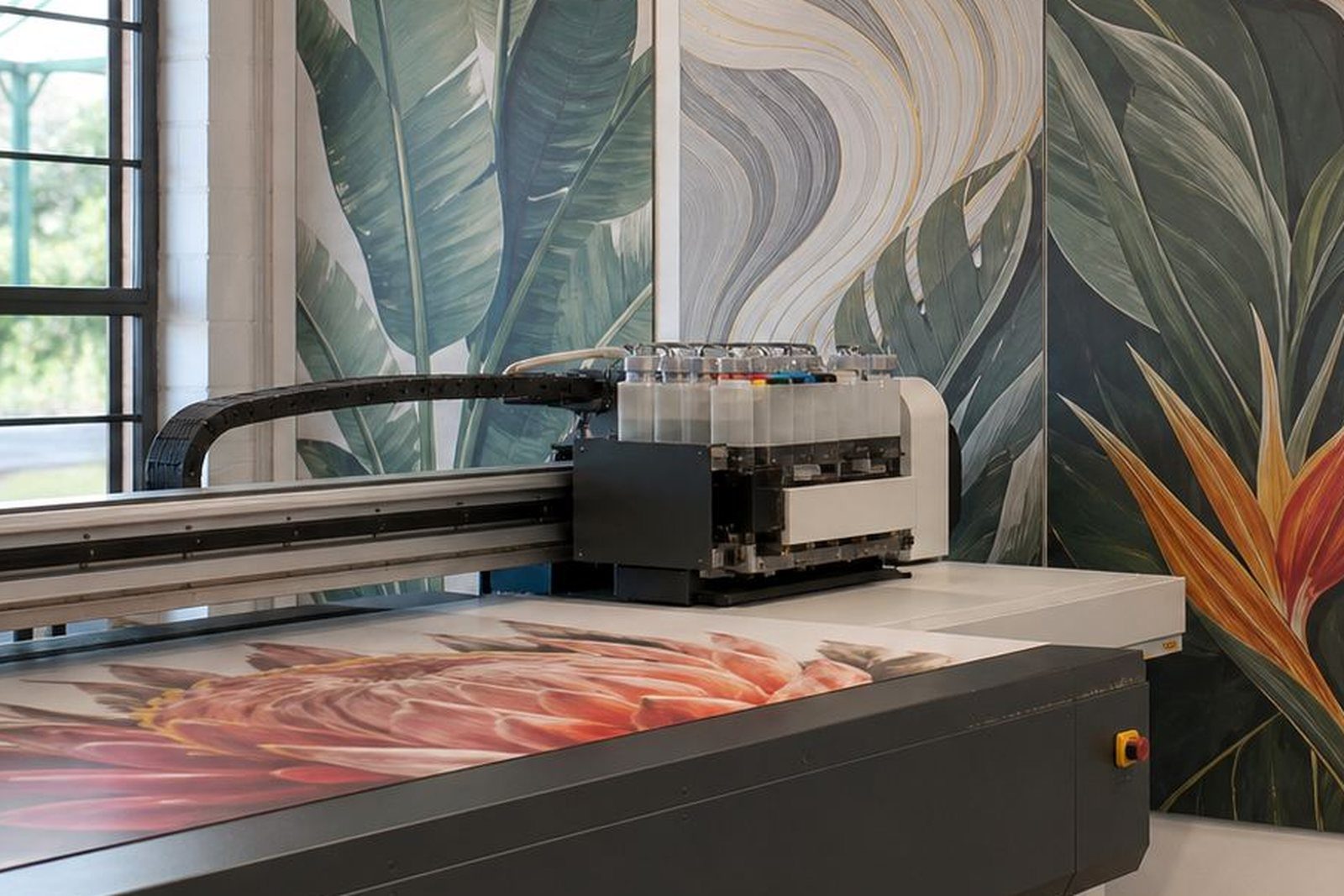
Wall decor work can look simple from the outside, but the substrate changes everything. A smooth PVC board, textured decorative board, self-adhesive wall covering or coated panel will each react differently to ink laydown and curing. In a Cape Town interior fit-out, for example, the same artwork may need to run on rigid boards for a reception wall and on roll media for a long corridor graphic. The ink has to hold detail on both, without cracking at cut edges or marking during handling.
For this kind of work, the client usually wants sharp detail, low odour after curing and colour that stays consistent across repeats. That is especially important in hotels, showrooms, offices and retail spaces where panels are made in batches over several days.
- Rigid decorative boards for feature walls
- Wallpapers and wall coverings on roll-to-roll machines
- Printed panels for retail, hospitality and office interiors
- Custom graphics for exhibition stands and temporary displays
Typical Printer Setups for Interior Graphics
Most wall decor production uses either a flatbed printer for boards and panels or a roll-to-roll printer for wallpaper and flexible wall media. Some print shops use both, because one job may need direct-to-board printing while another needs long repeat lengths and careful seam matching. The printer set-up matters, but so does the ink chemistry. UV-curable inks need the right balance of flow, adhesion and cure response so the image can be handled, trimmed and installed without trouble.
Compatibility checks are worth doing before a full production run. Even a good printer can give poor results if the ink and media are mismatched, or if the lamp output and carriage speed are not set correctly. Our team often helps customers plan test sheets first, then move to full panels once the finish, bond and colour are right.
- Flatbed printers for MDF, PVC, acrylic and composite boards
- Roll-to-roll printers for wallpaper and flexible decor media
- White ink setups for dark substrates or layered effects
- Primer or surface treatment where the material needs extra grip
Planning Colour, Texture and Finish Before Production
Wall decor is usually judged at close range, so planning has to include colour accuracy, curing and the final look under indoor lighting. A glossy finish can sharpen colour, while a matt look helps reduce glare in bright foyers and passageways. In Durban, where humidity can be high, the printer may also need a little more attention to media handling and storage so boards do not carry moisture into production. That can affect adhesion and edge stability.
If the job will be tiled across several panels, the file setup must allow for joins, bleed and registration marks. For wallpaper runs, repeat lengths should be checked carefully so pattern breaks do not become visible on the wall. The old habit of sending artwork straight to print without a sample often costs more later.
- Confirm whether the job will be viewed under warm or cool lighting
- Allow for joins, trims and fixing points on boards and panels
- Test one sample for colour, curing and edge adhesion
Adhesion Testing and Curing Guidance Save Rework
Adhesion is one of the main issues in wall decor production. If the ink does not bite properly, corners can chip, tape can lift paint layers and handled edges may scuff during delivery. This is why adhesion testing is part of a sensible workflow. Different wall decor materials can behave very differently, even when they look similar on paper. Decorative boards, for instance, may have coatings or release surfaces that need extra care.
Curing has to be matched to the printer speed and lamp output. Under-curing can leave the print soft or sticky, while over-curing may make the surface brittle. We advise clients to follow the safety data sheet for the ink, wear gloves when handling liquid ink and clean-up materials, and keep the work area ventilated. On a busy production floor, a small adjustment in speed or power can make a big difference to finish quality.
- Check adhesion on the actual substrate, not only on sample paper
- Use gloves for ink handling and follow the safety data sheet
- Keep UV lamps and print heads maintained to avoid uneven cure
- Store stock in a dry area, especially in coastal conditions
Common Mistakes on Wall Decor Orders
Many wall decor problems come from process mistakes rather than artwork itself. A team may choose the wrong surface, skip a sample, or forget that a textured board will show small print defects more clearly. Another common issue is rushing colour approval. What looks fine on a monitor can shift once cured and installed against paint, wood, glass or natural light. In Pretoria offices and Gqeberha showrooms, that light change can be enough to make a client ask for a reprint.
File prep also matters. Fine lines, dark solids and large white areas need different handling. White ink can improve coverage on dark media, but if it is overused or not cured correctly, it can slow down production. For repeat jobs, save the working settings and note the media type, because memory alone is never enough once the schedule gets busy.
- Skipping a test print on the exact board or wallpaper stock
- Using the wrong cure settings for the printer speed
- Not allowing for edge trim, mounting holes or panel joins
- Ignoring how indoor lighting changes colour perception
Budget Ranges for Small Runs and Larger Fit-Outs
Budget depends on the media, print size, ink coverage and the amount of testing needed before production. Small decorative runs for a home feature wall or a single retail panel can often be kept relatively tight if the artwork is ready and the substrate is straightforward. Larger fit-outs, especially those with multiple panel sizes or wallpaper repeats, need more planning and extra sample time.
As a broad working guide, a small test and sample stage may start from about R1,500 to R3,500, depending on how many substrates need checking. A short production run for one room or feature wall can sit in the range of R4,000 to R12,000. Bigger commercial decor orders, with several panels, colour trials and repeat printing, can move from R15,000 upwards. Courier delivery across South Africa is available, including Cape Town, Johannesburg, Durban, Pretoria and Gqeberha, and repeat order management can help keep the same ink set on hand for ongoing projects.
If you need guidance on ink selection, sample pack prep, remote tech help or safe handling briefing, write to UV Ink through the contact page form and send through the substrate details, printer model and job size. The more detail you share upfront, the easier it is to match the ink to the work.