
Why cleanliness matters more than most operators think
UV-curable inks behave well when the print room is managed properly, but they can be affected by dust, fibres, overspray, moisture and residue on hands or tools. Small contamination can show up as pinholes, poor adhesion, uneven gloss or patchy curing, especially on smooth rigid board or coated films. In coastal areas like Cape Town and Gqeberha, humidity can also make dust cling to surfaces and encourage static, which is never helpfull when you are trying to keep a clean line.
A clean work area supports repeatable results. That means better colour consistency, fewer reprints and less time spent troubleshooting problems that were really caused by the room, not the ink. For shops in Epping handling daily production, the habits below can save both time and material.
Set up a clean path from storage to the printer
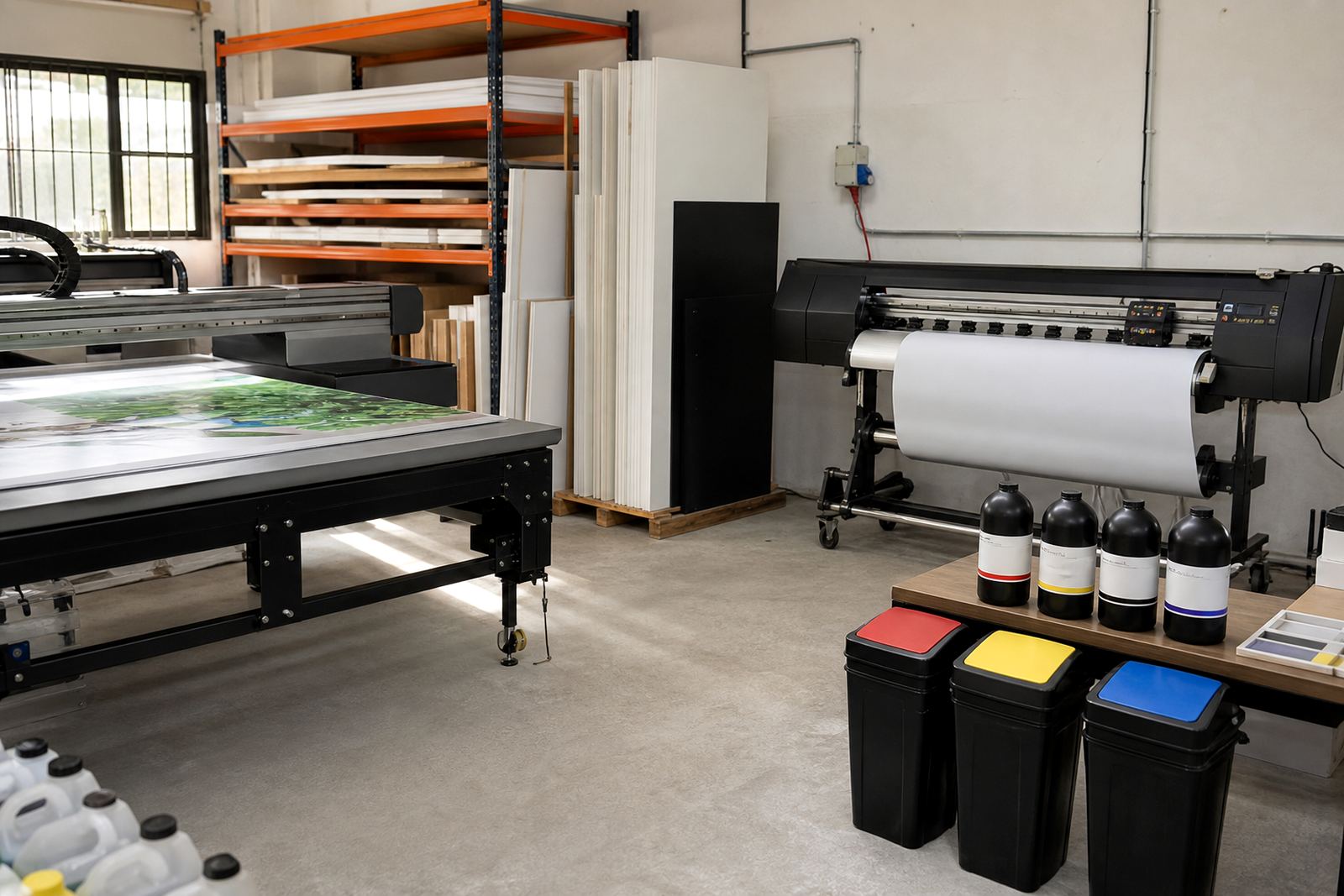
Good habits start before the ink reaches the machine. Keep storage off the floor, away from direct sun and away from open windows where dust can move in with the wind. In summer, a warm print room can soften labels and make caps harder to keep fully sealed, so every container should be closed immediately after use.
It also helps to separate clean and dirty zones. The place where you open cartons, decant samples or prep trial packs should not be the same surface used for wiping nozzles or cleaning rollers. Even a simple table layout can reduce cross contamination if the operator follows the same route every day.
- Store ink containers upright and sealed
- Keep lint-free cloths in a closed box
- Use a dedicated area for opening samples
- Wipe spills as soon as they happen
Hand, glove and tool discipline keeps contamination down
Operators often focus on the printer, but hands and tools are common sources of trouble. Skin oils can affect adhesion on some substrates and may leave marks on cleaned surfaces. That is why gloves should be worn when handling UV ink, sample media and any part that will be printed soon after cleaning. Follow the safety data sheet for the ink you are using and match your handling routine to it.
Use separate tools for ink handling and for general workshop cleaning. A rag used on a greasy trolley should never be used near a print head area. Hennie Opperman often tells customers that the cleanest room is not the one with the most products, it is the one where every item has a clear job. Simple, steady discipline is what keeps a shop productive.
- Wear gloves when handling ink and printed media
- Change gloves after cleaning or touching dusty surfaces
- Keep caps, funnels and stir tools dedicated to ink use only
- Do not place lids or nozzles on bare benches
Control dust, fibre and moisture before they reach the print
Dust is a quiet problem in many South African workshops. It comes in from doorways, open roller shutters, cardboard cartons and even clothing. Once it settles on the media or print bed, it can interfere with adhesion and leave tiny blemishes that are hard to spot until the job is finished. For roll-to-roll work, fibres can also build up on guide rollers and edge paths.
Try to reduce the sources first. Keep sweeping to a minimum while machines are running because dry sweeping lifts fine particles into the air. Better to vacuum, wipe and leave the room settled before production starts. In humid conditions, especially near the coast, store media in its wrapping until needed and do not leave rolls open overnight.
- Close doors during printing where possible
- Vacuum rather than dry sweep around production areas
- Keep media wrapped until it is ready for use
- Check corners, edges and rollers for trapped fibres
Cleaning routines should support curing and adhesion
UV ink needs the right curing behaviour to bond properly. If the surface is dusty, oily or damp, the ink may cure on top but still fail in use. That is why pre-print cleaning matters just as much as post-print finishing. Wipe down boards, check the condition of rollers and make sure the printer area is free from residue that could transfer to fresh work.
Where a job is sensitive, carry out a small adhesion test before full production. This is useful on unfamiliar substrates, textured materials or when changing between rigid and flexible media. A simple test piece can show whether the cleaning routine is good enough or whether the surface needs another pass. It is far cheaper to catch a problem on one sample than on twenty sheets.
A practical routine for Epping and beyond
In a busy Epping print room, the clean-up routine has to fit around real production pressure. A workable routine in the print room is better than an overcomplicated one. Start of day checks, mid-shift wipe-downs and end-of-day resets are usually enough if everyone follows the same sequence. When orders are moving to Johannesburg, Durban, Pretoria or Gqeberha, consistent handling matters because the job still has to look right when it arrives, not just when it leaves the floor.
For teams that train new operators, keep the routine written down and visible near the printer. That way no one has to guess what comes next.
- Do a quick bench wipe before each shift
- Inspect media edges and print beds before loading
- Reset tools and lids at the end of every job
- Log any contamination issue before the next run starts
Build habits that protect print quality day after day
Clean print room habits are really production habits. They protect adhesion, support curing and reduce the kind of small faults that waste time. If a room stays organised, operators can focus on colour, alignment and delivery deadlines instead of chasing problems caused by dust or residue.
UV Ink supplies UV-curable inks for flatbed and roll-to-roll printers, and our team can help with ink selection, compatibility checks, adhesion testing, curing guidance and operator training. If you are setting up a better routine, start with the basics: gloves, clean tools, closed containers and a clear path from storage to machine. Those small actions add up quickly.